

General Information
Product name
Pyrotechnic automotive safety devices, including: micro gas generators; airbag inflators; airbag modules; seat- belt pretensioners and retractors with pretensioners; igniters; actuators; fire suppression actuators and associ- ated subassemblies
1.2.1 Relevant identified uses
These articles shall only be used for safety devices in vehicles
Emergency telephone
(800) 424-9300, (703) 527-3887
Icons in SDS


Company Information
company name
1.3 Description of the company
e-mail address of the competent person responsible for the Safety Data Sheet
scott.detwiler@zf.com
GHS Information
Signal word
Warning
Hazard Codes
Hazard statements (CLP)
H204
Hazard statements
Code
Statements
H204
Fire or projection hazard
Section 2
SECTION 2: Hazards identification
These articles contain pyrotechnic components that are hermetically sealed off from the environ- ment. These cannot be released under normal or reasonably foreseeable conditions of use, includ- ing proper disposal. Integrated compressed gas containers: gases are under high pressure. Articles featuring unpressurized containers still may contain pyrotechnic components. Classification: Refer- enced safety devices are classified as either Class 9, 1.4, 2.1 or 2.2 according to UN and USDOT criteria. (Note: While pyrotechnic ingredients contained in the device represent an explosion haz- ard, the ingredients can only be released by destructive disassembly of the device). The safety de- vices do not present an explosion hazard when fully assembled. Classification of the article Referenced articles are classified as either Class 9, 1.4, 2.1 or 2.2 according to UN and US DOT criteria H204: Fire or Projection hazard
2.2 Label elements
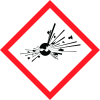
Hazard pictograms
GHS 01
Hazard statements
H204: Fire or projection hazard
Precautionary statements
P210: Keep away from heat/sparks/open flames/hot surfaces – No Smoking P250: Do not subject to grinding/shock/drop/friction. P370 + 380 In case of fire Evacuate area P374: Fight fire with normal precautions from a reasonable distance.
2.3 Other hazards
Risk of uncontrolled activation in case of fire, heat, electrostatic discharge, induction through elec- tromagnetic fields or greater mechanical load (e.g. shocks or falls). Risk from hazardous projectiles, quickly moving parts and/or high-speed gas jets released through activation. Risk of burn injuries in case of direct contact with articles heated by activation or with their reaction products (particles and gases). Risk of fire development if articles heated by activation come into contact with combustible or flammable material. Risk of eye and respiratory tract irritation from reaction products. Risk of blast trauma from high volume noise impulses during activation. Risk of frostbite injuries from release of gases that are stored under high pressure.
2.1 Classification of the substance or mixture
Referenced articles are classified as either Class 9, 1.4, 2.1 or 2.2 according to UN and US DOT criteria. H204: Fire or Projection hazard.


